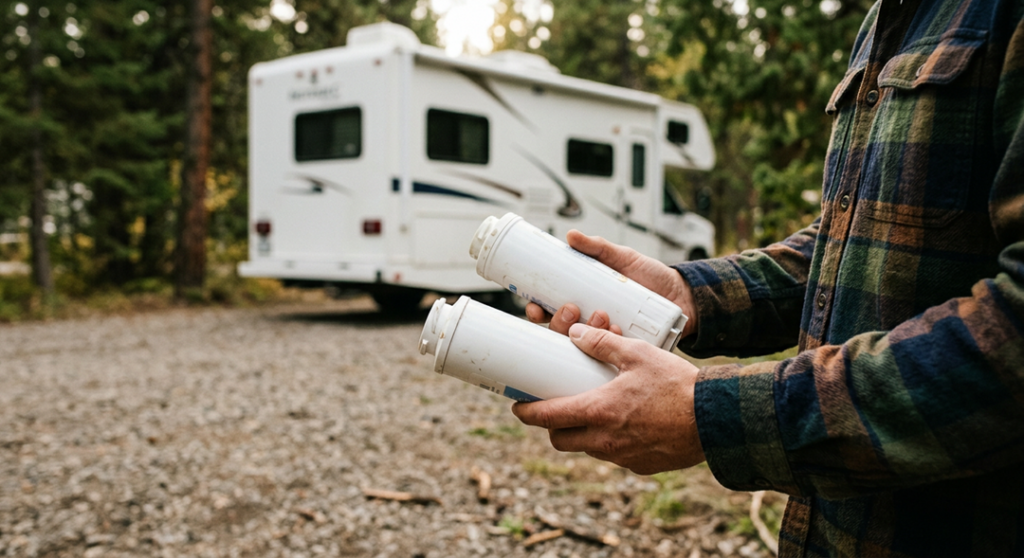
Last July I pulled into a dispersed site off Highway 93 south of Wikieup, Arizona, 107°F, no hookups, and the only water source was a livestock spigot at a ranch gate four miles back. I’d filled my van’s 20-gallon tank there, and without a solid inline filter on the outlet, every sip would have tasted like rust and cattle. That single afternoon is why I’ve cycled through five different inline RV water filters over the past six years and why I now run a specific two-stage setup as the best RV water filter system that I won’t leave a trailhead without.
Best RV Water Filter System: Quick Picks
If you want the short answer: the Camco EVO X2 Dual Stage Kit (Model 40639) is the strongest two-stage inline setup under $170 for full-time boondockers. The Waterdrop RV Inline Filter (B07X3YWDQJ) at around $25 is the best single-stage budget pick, NSF/ANSI 42 and 372 certified. The Camco TastePURE (around $20 to $28 on Amazon) remains a serviceable entry point but has real limitations in high-sediment desert water. The Clearsource Premier two-canister system is the premium choice if you have the budget and storage space. Keep reading for the breakdown of what I actually tested, what failed, and what’s worth your money.
Why RV Water Filter Systems Specs Matter Off-Grid
Most RVers shopping for a water filter focus on price. I get it, I did the same thing my first year. But after pulling sediment-heavy water from a Forest Service spigot outside Flagstaff in November 2022 and watching my single-stage carbon filter turn brown inside of two weeks, I started paying attention to specs.
Here’s what actually matters in the field:
Micron rating tells you the size of particles the filter physically blocks. A 5-micron sediment stage catches sand, silt, and rust. A 0.5-micron carbon block stage catches chlorine, VOCs, and cysts like Giardia. If you’re only running one stage, you’re making a tradeoff, either sediment protection or chemical reduction, not both.
Filter media type matters for taste. Granular Activated Carbon (GAC) reduces chlorine and odor but isn’t as effective on heavy metals. KDF (Kinetic Degradation Fluxion) media adds heavy metal reduction and inhibits bacterial growth in the filter itself. The Camco EVO line uses both KDF and GAC, which is why it outperforms cheap single-stage carbon-only filters on desert well water.
Flow rate gets overlooked until you’re trying to fill a 20-gallon tank in 90°F heat. The Clearsource 2-canister system flows at 6 to 6.5 gallons per minute at the campground spigot pressure I’ve tested it at. That matters when you’re rationing time at a shared water station.
The Products I’ve Actually Run: Specs and Honest Assessments
Camco TastePURE Inline Filter (Model 40042 / 40044)
This is where most people start, and it’s not a bad start. At $20 to $28 on Amazon, it uses activated carbon to reduce chlorine, bad taste, and odor. I ran a two-pack of these for my first two years boondocking in Oregon and Northern California, where municipal-sourced campground water is the norm.
The problem shows up when you hit the Southwest. In Arizona and New Mexico, where water sources can carry heavy sediment and higher mineral loads, the TastePURE clogs faster than its rated lifespan. I replaced one after just six weeks on a stretch from Quartzsite to the Gila River corridor. It’s not rated for sediment the way a two-stage system is, and once the carbon media is saturated, you get no warning, the flow just slows.
Best for: Part-time campers using established campgrounds with municipal water hookups.
Waterdrop RV Inline Filter (Model B07X3YWDQJ)
At around $25 on Amazon, the Waterdrop RV inline filter is NSF/ANSI 42 and 372 certified, that’s confirmed directly on the Amazon listing. It uses multi-stage filtration to reduce chlorine, lead, fluoride, and odor, and includes an anti-kink hose protector. Rated to last approximately 3 months under normal use.
I’ve used this as a backup filter on my van’s inlet hose for two seasons. The NSF certification gives it credibility the TastePURE doesn’t have on paper, and the flow rate held up well at a Prescott National Forest dispersed site where I was pulling from a slow-pressure forest spigot. At 3 months or roughly 200 gallons (whichever comes first), it needs replacement, and in heavy-use boondocking, 200 gallons goes fast if you’re not tracking.
Best for: Budget-conscious boondockers who want a certified single-stage filter and rotate it on schedule.
Camco EVO Single-Stage Filter (Model 40631)
The Camco EVO 40631 runs around $45 to $55 at Walmart and on Amazon. It includes a filter housing, a 12-inch extension hose, and a replaceable premium spun polypropylene cartridge. It uses KDF and GAC media, which is a meaningful upgrade over the TastePURE’s carbon-only approach.
I ran this for a full season on my van, spring through fall 2023, from the Alvord Desert in Oregon down through the Black Rock Desert in Nevada. It handled alkali-heavy Great Basin water better than anything I’d tried at that price point. The KDF media’s bacterial inhibition matters when your filter is sitting in 95°F heat between uses. That said, it’s still one stage. Sediment from surface-adjacent water sources (think stock tanks, slow-flowing rural lines) will shorten its life noticeably.
Best for: Solo boondockers in moderate-sediment regions who want KDF protection without the two-stage price.
Camco EVO X2 Dual Stage Kit (Model 40639)
This is the filter I run as my primary system now. The EVO X2 (SKU 40639) is a two-stage setup that includes two filter canisters, a built-in stand with rubber feet, a 4-foot RV fresh water hose, a canister wrench, and two cartridges: a 5-micron sediment/GAC/KDF first stage (item 40637) and a 0.5-micron carbon block second stage (item 40638). It retails around $165 to $210 at major retailers.
The 5-micron first stage catches the bulk sediment that would otherwise destroy your carbon block in two weeks. The 0.5-micron second stage handles chlorine, VOCs, cysts, and finer contaminants. Running these in series at a questionable stock tank spigot near Wickenburg, Arizona last March, I pulled the first-stage cartridge after 30 days, it was visibly brown with sediment. The second stage was still clean. That’s the system working exactly as designed.
The stand with rubber feet is more useful than it sounds. On rocky desert ground, having a stable platform for the canisters means you’re not wrestling with a hose that wants to tip everything over. My one complaint: the canister wrench is plastic and I’ve cracked one. I now carry a rubber strap wrench as backup.
Best for: Full-time boondockers in high-sediment regions (Southwest, rural West) who want the most complete inline protection without going to a whole-house system.
Clearsource Premier Two-Canister System
The Clearsource Premier is the premium option in this category. It’s a two-canister portable whole-RV system with 0.2-micron absolute-rated filtration, meaning every pore in the filter membrane is rated at or below 0.2 microns, not just a nominal average. The system dimensions are 15″ wide × 15.25″ tall × 7.5″ deep and it weighs 24 pounds. Flow rate is 6 to 6.5 gallons per minute. It’s available at Camping World and on Amazon.
I borrowed a friend’s Clearsource Premier for two weeks on a run through the Sonoran Desert in February 2024. The flow rate is noticeably faster than the EVO X2 at low campground pressure. The 0.2-micron absolute rating gives it better protozoa protection than the EVO X2’s 0.5-micron second stage. The tradeoff is price (significantly higher than the EVO X2), size, and the 18-pound weight. For a Class B van, that’s a lot of real estate. For a Class C or travel trailer with exterior storage, it’s a different calculation.
Best for: Full-timers with larger rigs who want the highest filtration level and can accommodate the footprint.
Inline RV Water Filter Comparison Table
| Filter | Type | Key Media | Micron Rating | Price Range | Best Use Case |
|---|---|---|---|---|---|
| Camco TastePURE (40042) | Single-stage inline | Activated Carbon | Not specified | around $20 to $28 | Part-time, municipal hookups |
| Waterdrop RV (B07X3YWDQJ) | Single-stage inline | Multi-stage, KDF/GAC | Not specified | around $25 | Budget boondocking, NSF certified |
| Camco EVO (40631) | Single-stage canister | KDF + GAC | Not specified | around $45 to $55 | Moderate sediment, solo van |
| Camco EVO X2 (40639) | Two-stage canister | KDF/GAC + Carbon Block | 5-micron (stage 1), 0.5-micron (stage 2) | around $165 to $210 | Full-time boondocking, high sediment |
| Clearsource Premier | Two-stage canister | Proprietary two-stage | 0.2-micron absolute (stage 2) | Higher end | Large rigs, max filtration |
How to Set Up an Inline RV Water Filter for Boondocking: Step by Step
This is the setup process I use every time I arrive at a new dispersed site with a water source. It takes under five minutes once you’ve done it twice.
- Flush the filter before connecting to your tank. Run water through the filter for 30 to 60 seconds into the ground, not into your tank. New filters and cartridges can release carbon fines that taste terrible. Skip this step once and you’ll never skip it again.
- Connect the inlet hose from the water source to the filter’s inlet port. On the EVO X2, the inlet is marked. Hand-tighten only, over-tightening the plastic fittings cracks them.
- Connect the outlet hose from the filter to your RV’s city water inlet or tank fill port. Keep this hose as short as practical to reduce pressure drop.
- Check the stand or positioning. On uneven desert ground, I use a flat rock or a small piece of plywood under the EVO X2’s stand to keep it level. A tipped canister at 60 PSI will leak at the housing seal.
- Turn on the water slowly. Let pressure build gradually rather than opening the spigot full blast. Sudden pressure spikes can unseat filter cartridges.
- Mark your install date on the canister with a paint marker. I write the date and the water source type (municipal, well, surface-adjacent) directly on the housing. This is the only way to track actual filter life in the field.
- Inspect the first-stage cartridge at 30-day intervals in high-sediment conditions. Pull it, hold it up to light, and compare it to a new cartridge. Heavy discoloration means replace it, don’t wait for flow to drop.
What Inline Filters Don’t Do, Honest Limitations
I want to be direct about this because it affects decisions in remote areas. Standard inline RV filters, including the EVO X2 and the Clearsource Premier, are not virus filters. They remove bacteria, protozoa, sediment, chlorine, and heavy metals, but viruses require either a UV purification stage or a virus-rated membrane filter. In the rural Southwest and on cross-border routes, that matters.
If you’re pulling water from sources with unknown upstream contamination, not just a municipal spigot with high chlorine, consider adding a UV purifier like the SteriPen or a dedicated virus-rated filter downstream of your inline system. I carry a SteriPen Adventurer Opti as backup specifically for this scenario.
Also: no inline filter compensates for a dirty fresh water tank. Sanitize your tank with a diluted bleach solution at least twice a year, and flush thoroughly before relying on filtered water from a previously stagnant tank.
My RV Water Filter System Setup After 6 Years Boondocking
After six years and dozens of water sources from the Owyhee Desert to the Chihuahuan Desert, I run the Camco EVO X2 (40639) as my primary inline system on the van’s city water inlet and a Waterdrop inline filter on the tank outlet as a secondary point-of-use stage. Total investment: under $200. Together they handle sediment, chlorine, heavy metals, and cysts across every water source I’ve encountered.
If you’re just starting out and want one filter under $30 with a real certification behind it, the Waterdrop NSF/ANSI 42 and 372 certified inline is where I’d put my money before I’d put it in a TastePURE. If you’re full-timing in the Southwest and pulling from anything other than a clean municipal spigot, the EVO X2 is worth every dollar of the $165 price tag.
Check current pricing on the EVO X2 before you buy, it fluctuates, and I’ve seen it as low as $140 on Amazon during seasonal sales. Don’t buy the X2 without also ordering a spare set of both cartridges (40637 and 40638) at the same time. Running out of replacement filters at a remote BLM site is a problem I’ve solved exactly once by driving 90 miles to the nearest hardware store. Don’t repeat my mistake.
Dex Calloway has been boondocking full-time since 2020 across BLM land, Forest Service roads, and desert flats from Oregon to Arizona. He tests gear in the field, not in parking lots.