Last April I was parked on a BLM flat outside Quartzsite with no water hookup, 97°F by noon, and a silty stock tank about 400 yards from my van as my only source. I had both a Sawyer Squeeze and a LifeStraw clipped to my pack. By day three, one of them was sitting in my gear bin unused. Here’s the honest breakdown of what happened and which filter I’d trust for long-term boondocking. This Sawyer Squeeze vs LifeStraw comparison is based on real desert conditions, not a parking lot test.
This post contains affiliate links. If you buy through my links I may earn a small commission at no extra cost to you.
Quick-Take Summary
If you’re skimming: the Sawyer Squeeze wins for full-time RV boondocking, and it’s not close. The LifeStraw is a solid emergency backup but fails as a daily-use camp water system the moment you need to fill a container, cook a meal, or share water with a partner. The Sawyer Squeeze filters into any vessel, works as a gravity rig, and has a 100,000-gallon rated lifespan versus the LifeStraw Personal straw’s rated minimum of 1,000 liters (264 gallons) – note that newer LifeStraw Personal packaging now lists up to 4,000 liters (1,000 gallons) on some retail listings, so verify the model you purchase. For a weekend hiker, the LifeStraw makes sense. For someone living out of a van for months at a stretch – it doesn’t.
What I Was Actually Testing (And Why It Matters for RV Boondocking)
I’ve been boondocking full-time for six years out of a converted Dodge Sprinter. My Class B carries a 20-gallon fresh tank plumbed to a hand pump, but in remote desert and high-desert spots – think the Owens Valley in July or the Gila National Forest in late September – I regularly supplement from natural sources or community water stations that I pre-filter before it ever touches my tank. The tank has a faint mineral smell after a week without a full flush, which is part of why I’m obsessive about what goes into it. I’m not filtering creek water into a cup to sip through a straw. I’m filtering 2 to 4 liters at a time into a Nalgene, a cook pot, or my van’s tank directly.
That use case is where the LifeStraw immediately shows its limits.
The LifeStraw personal filter weighs 2 oz and costs around $15 to $20 depending on where you buy it, with the MSRP at $19.95 and frequent sale pricing below $16. The LifeStraw Personal’s rated lifespan of 4,000 liters (1,000 gallons) – the current production model (verified on LifeStraw’s own site) carries this updated rating; older listings and some Amazon Q&A threads still cite the legacy 264-gallon figure, so confirm the spec on the specific listing before buying – and filters at 0.2 microns. You drink directly through it – mouth to straw to water source. There is no way to fill a bottle hands-free, no way to run a gravity drip, and no way to filter water for cooking without awkward workarounds involving syringes or adapters that aren’t included.
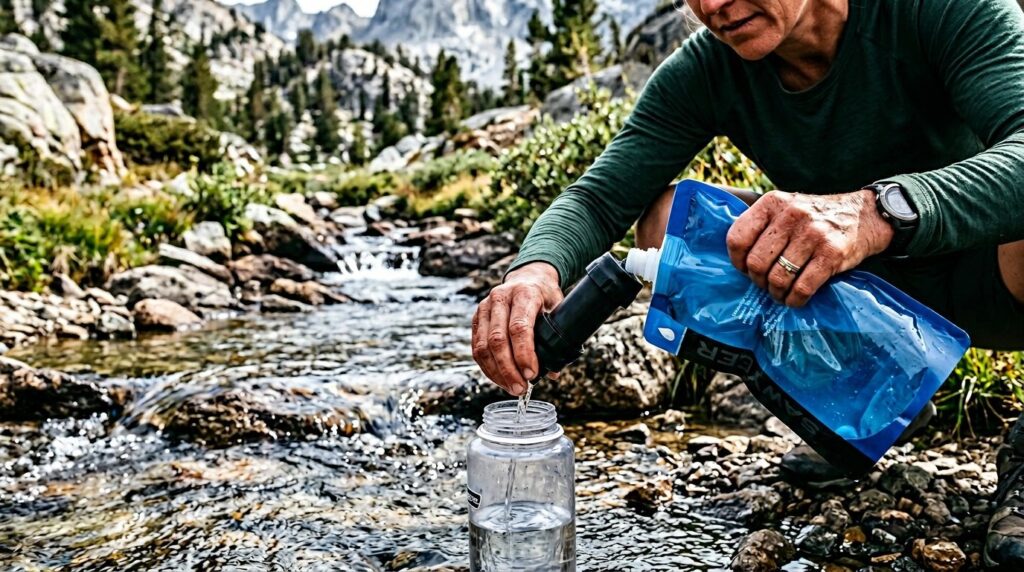
The Sawyer Squeeze runs about $46 at direct retail and weighs 3 oz for the filter alone. Sawyer Squeeze Water Filtration System It filters at 0.1 microns – tighter than the LifeStraw – and is rated to 100,000 gallons. You squeeze a flexible pouch to push water through the filter into any container. That single design choice makes it infinitely more useful for camp life.
The Day-Three Failure That Ended the LifeStraw Test → Sawyer Squeeze vs LifeStraw: The Day-Three Field Failure
On day three at that Quartzsite flat, I needed to filter about 3 liters to top off my drinking supply before a long drive to Yuma. The stock tank water was murky – fine sediment, not dangerous but visibly cloudy. I tried the LifeStraw first. After about 20 minutes of awkward kneeling and direct sipping, I had maybe 600 ml filtered into a separate bottle using a DIY syringe-push method.
My knees hurt. My back hurt. The flow rate had already started slowing from the sediment load.
I switched to the Sawyer Squeeze. Filled the included 32 oz pouch, squeezed it through the filter into my Nalgene. Repeated three times. Done in under eight minutes. The LifeStraw went into my emergency kit – where it has stayed ever since. It’s a fine backup. It is not a daily driver for off-grid living.
Spec Comparison: Sawyer Squeeze vs LifeStraw Personal
| Feature | Sawyer Squeeze | LifeStraw Personal |
|---|---|---|
| Filter weight | 3 oz | 1.6 oz |
| Filtration pore size | 0.1 micron | 0.2 micron |
| Rated lifespan | 100,000 gallons | 264 gallons min (1,000 liters); up 1,000 gallons (4,000 liters) on current production model – legacy listings may show 264 gallons; confirm before buying |
| Fills external containers | Yes | No (requires adapter hack) |
| Gravity filter capable | Yes | No |
| Backflushable | Yes | No |
| Approximate retail price | around $46 | around $15 to $20 |
| Best use case | Full-time boondocking | Emergency/day hike backup |
The lifespan gap tells the whole story – even using the updated 4,000-liter figure on newer LifeStraw Personal models, the Sawyer Squeeze’s 100,000-gallon rating is in a different league. At 264 gallons on the classic model, a full-time boondocker who filters 2 gallons a day burns through a LifeStraw personal in about four months. Even at 1,000 gallons on the updated version, you’re replacing it inside 18 months. At 100,000 gallons, the Sawyer Squeeze is effectively a lifetime filter for van life use. The math on cost-per-gallon isn’t even close.
How to Set Up a Sawyer Squeeze Gravity Filter at Camp
This is the setup I’ve been running for two years. It takes about four minutes to rig and gives me hands-free filtered water while I cook dinner – no squeezing required.
For contaminant removal benchmarks check EPA drinking water standards, modern off-grid systems benefit from verified data when sizing components for real-world use.
- Fill your dirty water pouch. I use a 2-liter CNOC Vecto bladder instead of the stock Sawyer pouch – it’s more durable and holds more volume. Fill it from your source.
- Thread the Sawyer Squeeze filter onto the bladder’s opening. The Sawyer Squeeze uses a standard 28mm thread that fits most soft flasks and hydration bladders.
- Hang the dirty pouch from a high point. I use a carabiner clipped to my awning arm or a tree branch. You need at least 18 inches of drop for decent gravity flow.
- Place your clean container below the filter output. I use a 1-liter Nalgene or my cook pot directly.
- Open the pouch valve and let gravity do the work. Expect roughly 0.5 to 1 liter per 10 minutes depending on how clogged the filter is. Fresh-backflushed filter with clean source water moves faster.
- Backflush after every 2 to 3 uses in silty conditions. Use the included syringe to push clean water backward through the filter. Takes 60 seconds.
- Store the filter dry. In cold nights – anything below freezing – bring the filter inside your van. Frozen hollow fiber membranes crack and the filter is ruined. I learned this the hard way at 9,200 feet outside Flagstaff in November.
Sawyer Squeeze Water Filtration System
Flow Rate and Backflushing: What No One Tells You
The Sawyer Squeeze’s biggest real-world limitation is flow rate degradation. In clear mountain stream water, it flows fast – close to the factory spec. In the Mojave filtering from a silty cattle tank, it slowed to a trickle within two fill cycles.
The fix is backflushing, and you need to do it more aggressively than Sawyer’s instructions suggest if you’re pulling from turbid desert sources. I backflush every 2 to 3 days of heavy use, not just when the flow slows. Pre-filtering through a bandana or coffee filter before it hits the Sawyer pouch also extends time between backflushes significantly.
One thing to know: the stock squeeze pouches that come with the Sawyer Squeeze are fragile. They develop pinholes after 30 to 40 uses. I replaced mine with the CNOC Vecto bladder after about two months on the road and never looked back. The filter itself is the durable part – the pouch is consumable. CNOC Vecto 2L Water Container
Cold Weather Warning: The Freeze Problem Both Filters Share
Both the Sawyer Squeeze and the LifeStraw use hollow fiber membrane technology. When those membranes freeze, the water inside them expands, cracks the fibers, and the filter no longer stops pathogens – but it still flows water, so you’d never know it was compromised unless you tested it.
I left my Sawyer Squeeze in my truck bed on a 28°F night outside Sisters, Oregon in October. When I checked it in the morning, the filter body felt fine. But I’d read enough field reports to know I couldn’t trust it. I replaced it rather than risk it.
The rule I follow now: if overnight temps drop below 34°F, the filter sleeps inside the van with me. I keep it in a small dry bag tucked next to my sleeping bag in shoulder season. In winter desert camping – Joshua Tree in January, for example – this is non-negotiable.
For baseline water quality reference CDC water safety guidelines, modern off-grid systems benefit from verified data when sizing components for real-world use.
Who Should Buy the LifeStraw (And Who Definitely Shouldn’t)
When it comes to the Sawyer Squeeze vs LifeStraw decision for full-time boondockers, the use case gap is wider than the price gap. At $15 to $20, it’s an affordable emergency kit item. LifeStraw Personal Water Filter If you’re a weekend camper who wants a lightweight backup for day hikes from your campsite, or you want something to toss in a glove box for emergencies, it delivers. It’s also genuinely useful for international travel where you’re drinking from a single source and not trying to supply a camp kitchen.
Where it fails for boondockers:
- You can’t fill a water bottle passively. Every ounce requires you actively sucking through the straw.
- It’s not backflushable. Once it clogs from silty water, it’s done.
- Lifespan is short for full-time use. Even the updated 4,000-liter model gets replaced more often than you’d like at this price point, and the classic 264-gallon version disappears in months.
- No gravity or inline configuration. It only works one way.
If you’re committing to off-grid van life or extended boondocking, the LifeStraw personal is not your primary filter. The Sawyer Squeeze is.
Building a Full Boondocking Water Kit Around the Sawyer Squeeze
After 18 months of running the Sawyer Squeeze as my primary filter, here’s what I pair it with for a complete off-grid water system inside a Class B:
- Sawyer Squeeze as the primary field filter for sourced water
- CNOC Vecto 2L bladder replacing the stock Sawyer pouch
- Pre-filter bandana or coffee filter for high-sediment sources
- 5-gallon collapsible water cube WaterStorageCube Collapsible Water Container for camp water storage – I fill this filtered, so everything that comes out of it is already clean
- LifeStraw personal in the emergency kit, not the daily kit
Total weight for this entire system: under 2 lbs. It fits in a single dry bag hanging from my van’s side wall. I’ve run this setup from the Oregon coast in February – cold, constant rain, pulling from roadside streams – to the Sonoran Desert in July at over 100°F. The Sawyer Squeeze has never failed me when I’ve maintained it properly.
The Filter That Earns a Permanent Spot in My Daily Kit
The Sawyer Squeeze is the right filter for anyone boondocking more than a weekend at a time. At roughly $46, its 100,000-gallon lifespan, 0.1-micron filtration, gravity-rig capability, and backflushable design make it the most practical portable water filter I’ve used in six years of full-time van life. Grab your Sawyer Squeeze and pair it with a quality replacement bladder – the CNOC Vecto 2L is the upgrade I’d make on day one – your daily water routine will be cleaner, faster, and more reliable than anything the LifeStraw personal can offer in a real boondocking scenario.
The LifeStraw earns a spot in your emergency bag. The Sawyer Squeeze earns a spot in your daily kit. Don’t mix those up when you’re 40 miles from the nearest tap.