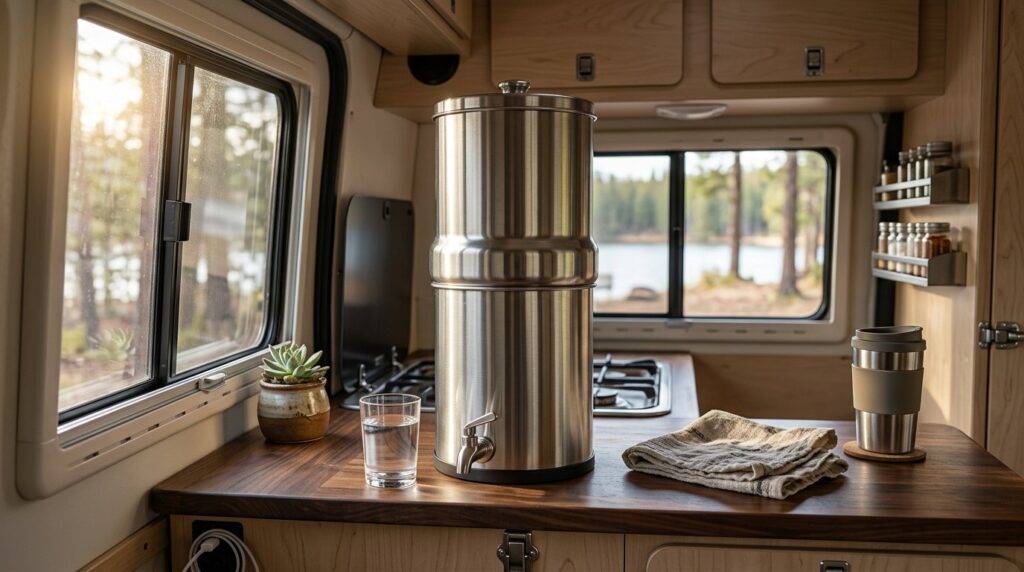
The Travel Berkey water filter earned its place in my van the first time I filled it at a sketchy cattle-tank spigot outside Quartzsite, Arizona. What came out was clean, flat, and cold, and I drank two full cups standing in 103-degree January desert heat before I got back in the van.
This post contains affiliate links. If you buy through my links I may earn a small commission at no extra cost to you.
Quick-Take Summary for Skimmers
The Travel Berkey water filter is a 1.5-gallon, 18-inch-tall stainless gravity filter that costs around $367 and runs with zero electricity. For a solo boondocker or couple in a Class B or Class C, it delivers clean drinking water from questionable sources without touching your 12V system. Its main limitations: it’s tall (tight under overhead cabinets), slow-fills if you’re drawing more than 2 gallons a day, and Black Berkey replacement elements have been discontinued as of 2024 due to the EPA stop-sale order – meaning you’ll need to source compatible third-party elements such as ProOne G2.0 before buying. If you want a smaller, cheaper alternative, the LifeStraw Home pitcher at roughly $49 covers the basics but can’t touch the Berkey’s contaminant range or output capacity. Full breakdown below.
Why Gravity Filtration Is the Right Call for Boondocking
I’ve run a 200W solar setup on my Sprinter for six years. Power is always a negotiation – the Maxxair fan, the ARB fridge, the phone chargers, the occasional laptop. Adding a 12V pump-fed inline filter is fine until you’re parked under trees in November at Dispersed Camping Area 7 off Forest Road 65 near Flagstaff and you’re pulling 4 amps of cloud-day solar. A gravity filter uses exactly zero watts. That single fact puts it ahead of every UV pen and pressure-pump system in my kit for long stays off-grid.
Gravity filtration also fails gracefully. There’s no motor to burn out on a washboard road, no battery to drain, no cartridge that needs a pressure differential to function. You pour water in the top. Gravity pulls it through the filter elements. Clean water collects below. That’s the whole system.
Travel Berkey Specs That Actually Matter for Van Life
Here’s what the spec sheet says, and here’s what it means on the road:
- Height: 18 inches fully assembled. This is the number that will make or break your install. My Sprinter galley has 19.5 inches of clearance under the overhead cabinet. I have exactly 1.5 inches of margin. I cannot fill the top chamber without tilting the upper chamber off – a two-handed operation every single time. Measure your clearance before you order.
- Diameter: 7.5 inches. Compact enough to sit on a 10-inch-wide shelf rail without overhang.
- Capacity: 1.5 gallons total. For one person drinking 1 gallon of filtered water per day, you’re refilling the upper chamber once daily. For two people, twice. That’s manageable.
- Flow rate: up to 2.5 gallons per hour with two Black Berkey elements installed. In practice, I see closer to 1.5 GPH when the upper chamber is half-full and the elements are a year old. Plan accordingly.
- Weight: 6 lbs empty. Add 12.5 lbs when the lower chamber is full. Secure it. I’ll get to that.
Travel Berkey Gravity-Fed Water Filter with 2 Black Berkey Elements – The Travel Berkey with two Black Berkey elements is the version I run and recommend for van and Class B setups.
The EPA Stop-Sale: What It Means If You’re Buying in 2026
The EPA conducted an inspection of Berkey International in November 2022 and subsequently issued a formal Stop Sale, Use, or Removal Order (SSURO) in 2023, specifically targeting the Black Berkey filter elements because they contain silver as an antimicrobial agent – which the EPA classifies as a pesticide requiring registration. Berkey did not register. The company went through a period of serious disruption, including a bankruptcy filing.
Here’s the practical reality for RVers in 2026: The Travel Berkey stainless steel system itself is not the issue. The stainless housing is just a vessel. The controversy is about the Black Berkey elements. Black Berkey elements have been formally discontinued as of 2024. Compatible third-party elements – most notably ProOne G2.0 and BOROUX Foundation Filters – are available and fit the stainless housing, but you will not be able to purchase original Black Berkey elements new. Confirm which replacement elements ship to your state before ordering the system.
If you already own a Berkey system and your elements are approaching their rated 3,000-gallon lifespan, check current stock of compatible third-party elements before you’re dry-camped in the Owyhee Desert with a filter that won’t flow. I keep a spare set in my storage bay specifically because of this supply reality.
ProOne G2.0 7-Inch Gravity Filter Replacement 2-Pack – Replacement ProOne G2.0 elements (2-pack) are the compatible consumable to stock up on – confirm availability before you need them.
For contaminant removal benchmarks, the EPA’s National Primary Drinking Water Regulations are the authoritative reference.
Travel Berkey Water Filter vs. LifeStraw Home: Which Wins for RV Boondocking
I ran both units back-to-back – two weeks each – during a spring stretch from the Alvord Desert in southeast Oregon down through the Nevada basin. Here’s the honest comparison:
| Feature | Travel Berkey | LifeStraw Home (7-cup) |
|---|---|---|
| Price | around $367 | around $49 |
| Capacity | 1.5 gallons | approx. 0.44 gallons (7 cups) |
| Height | 18 inches | approx. 11.25 to 12.5 inches |
| Filter lifespan | approx. 3,000 gallons (per manufacturer) | 264 gallons (membrane); 40 gallons (carbon/ion exchange) |
| Electricity needed | None | None |
| Removes bacteria/parasites | Yes | Yes |
| Removes heavy metals (lead) | Yes (compatible elements) | Yes (ion exchange) |
| Removes PFAS | Yes | Yes |
| Travel vibration stability | Heavy, stable | Light, tips easily |
| Countertop footprint | 7.5″ diameter | 5.8″ wide |
The LifeStraw Home is a good filter for the price. Its 0.2-micron hollow-fiber membrane catches bacteria and parasites, and the ion-exchange stage handles lead and PFAS. For a weekend camper or someone who supplements with store-bought water, it works. But the LifeStraw Home uses a two-stage system: the membrane microfilter lasts 264 gallons (approx. 4 months at 2 gallons/day), but the activated carbon + ion exchange filter lasts only 40 gallons – roughly every 3 weeks at that usage rate. That means the carbon filter alone costs $15-20 every few weeks, making the true ongoing cost significantly higher than the membrane lifespan suggests.
The Berkey’s 3,000-gallon element claim, even if real-world performance is closer to 2,000 gallons with sediment-heavy desert sources, still trounces the LifeStraw on cost-per-gallon over a full season.
The LifeStraw also tipped over twice during hard-braking events. The Travel Berkey, full of water, never moved – it’s simply too heavy to tip without a serious impact.
LifeStraw Home 7-Cup Water Filter Pitcher – The LifeStraw Home 7-cup pitcher is the right call if counter clearance under 13 inches is your hard constraint, or budget is tight.
How to Secure Your Travel Berkey for Moving Days
After my Travel Berkey slid off the galley shelf on a rutted two-track outside Silver City, New Mexico – soaking my passenger seat and losing a full lower chamber of filtered water – I built a proper mount. Here’s the exact setup I built after that – took about an hour and has held for 14 months since.
Materials needed:
– 2x adhesive-backed non-slip shelf liner strips (cut to 7.5″ circle)
– 1x adjustable bungee cargo net (18″ x 18″ minimum)
– 2x stainless steel D-ring hooks screwed into cabinet face
– 1x rubber shelf lip (3/4″ tall) glued to front edge of shelf
Process:
- Empty the lower chamber completely before any drive over 30 minutes. A full 1.5-gallon lower chamber weighs over 12 lbs and will shift the center of gravity above the base – that’s a tip waiting to happen.
- Place the non-slip liner under the base. Cut it to match the 7.5-inch diameter. This alone stops 80% of sliding on smooth road.
- Install the rubber shelf lip on the front edge of the shelf using construction adhesive. Let cure 24 hours. This creates a physical stop.
- Screw the D-ring hooks into the cabinet face on either side of the Berkey’s position, at the height of the upper chamber’s midpoint.
- Run the bungee cargo net over the top of the assembled Berkey, hooking both ends to the D-rings. It should have light tension – not crushing the unit, just restraining it.
- Test by pushing the unit firmly from each side before driving. If it moves more than a half-inch, tighten the bungee.
This setup has survived 14 months of full-time use including washboard Forest Service roads in Oregon and rocky two-tracks in the Superstition Wilderness area outside Phoenix.
Heavy Duty Bungee Cargo Net for RV Cabinet Interior – A quality bungee cargo net rated for at least 50 lbs of load is the right tool for this mount.
How to Fill and Maintain the Travel Berkey Off-Grid
One thing nobody tells you before you buy: the Travel Berkey’s upper chamber has to come off the lower chamber to fill it. That means you’re lifting the upper body (with whatever water is still in it) and setting it aside, then pouring raw source water in. In a 6-foot-2-inch van with a low ceiling, this is a two-move operation. I fill from a 7-gallon Aquatainer using a silicone funnel, which keeps the pour controlled and splash-free.
Maintenance on the road is simple:
– Backwash the elements with the included primer bulb every 30-60 days, or whenever flow rate drops noticeably. In desert conditions with high sediment, I do it every three weeks.
– Wipe the stainless chambers with a damp cloth monthly. Never use soap inside the lower chamber – it leaves residue that flavors the water.
– Store dry if you’re parking the van for more than a week. Wet elements stored in a closed chamber can develop biofilm.
Winlauyet 3-Pack Silicone Collapsible Funnel Set – A silicone collapsible funnel makes filling the upper chamber from a large water jug significantly cleaner and faster.
Berkey Alternatives Worth Considering in 2026
If the element discontinuation makes you uncomfortable buying into the Berkey ecosystem right now, or if the $367 price point is a stretch, here are two alternatives I’ve personally tested:
For baseline water quality guidance, the CDC’s home water filter selection guide, is worth reading before you buy.
ProOne G2.0 filter elements are compatible with the Berkey stainless housing and are NSF/ANSI 42 and 53 certified – meaning independent lab verification, which the original Black Berkey elements lacked. Flow rate is slightly slower, but the certification matters if you’re sourcing from unknown wells or agricultural runoff areas.
Alexapure Pro is a similar stainless gravity system at a comparable price point with certified elements. The filter footprint is slightly larger (8.5-inch diameter vs. 7.5 inches for the Berkey), which matters in tight van galleys.
For pure budget minimalism, the Sawyer Squeeze hung from a cabinet hook with a 1-gallon dirty bag and a clean collection container below costs under $40 and filters to 0.1 micron. I tested this setup for two weeks in the Gila Wilderness – it works, but the slow drip rate (about 0.5 gallons per hour when the bag is half-empty) and the complete absence of chemical or heavy-metal filtration make it a backup tool, not a daily driver. It won’t touch heavy metals or chemicals, but for microbiological safety from backcountry sources, it’s hard to argue with the price.
ProOne G2.0 7-Inch Gravity Filter Replacement 2-Pack – ProOne G2.0 elements are my current primary recommendation for anyone who already owns a Berkey stainless housing and needs certified replacement elements.
My Recommendation
Six years of boondocking across BLM flats and high-desert forest roads have taught me one thing about water: the system that runs without electricity, without complexity, and without a trip to town is the one you’ll actually use every day.
The Travel Berkey water filter is that system for me – with caveats. At $367, it’s a real investment. The Black Berkey elements are discontinued, so you’ll be running ProOne G2.0 or BOROUX-compatible elements from day one. And at 18 inches tall, you must measure your cabinet clearance before ordering.
But it has filtered every questionable source I’ve thrown at it – cattle tank spigots, campground faucets with sulfur smell, and a hand-pump well in rural Nevada – without complaint for over a year.
If the height or price is genuinely prohibitive, the LifeStraw Home at $49 is a real filter, not a toy. Just go in knowing that the carbon and ion exchange stage needs replacement every 40 gallons – far more often than the membrane lifespan implies. For full-time off-grid water, the Berkey housing with certified third-party elements is still the unit I trust.
Travel Berkey Gravity-Fed Water Filter with 2 Black Berkey Elements – Grab the Travel Berkey water filter stainless housing, confirm compatible element availability for your state, measure your cabinet clearance, and build the bungee mount before your first drive day. Six years in, it’s still the first thing I reach for when I pull into a new camp and don’t know what’s in the water.