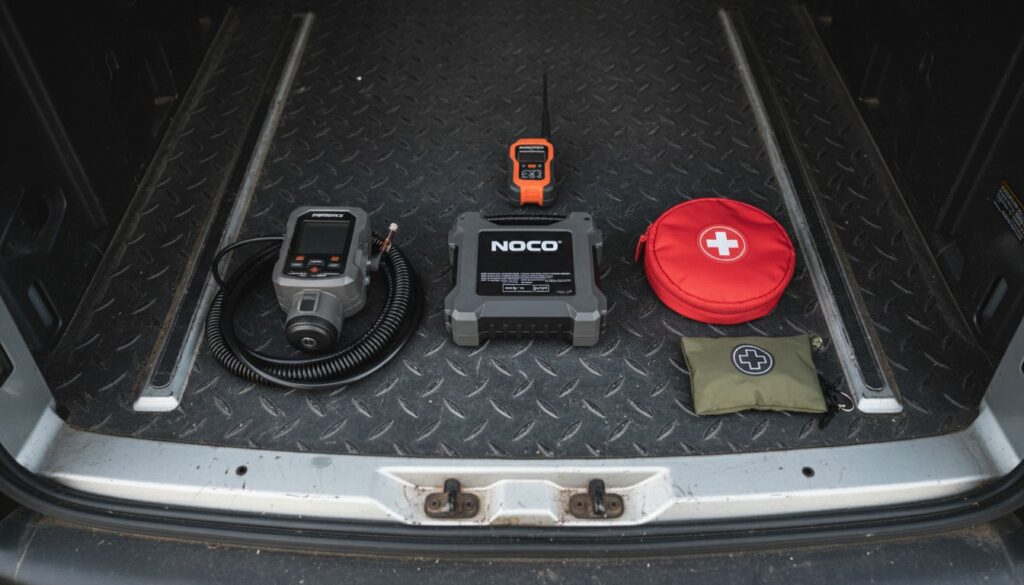
Last March, I was parked on a forest service road outside of Moab, Utah, 22 miles from pavement, when my van’s battery decided it was done. Overnight temps had dropped to 19°F, my phone had 11% battery, and the nearest cell signal was back at the highway. I got out of that situation in under 30 minutes because my emergency kit was dialed in. The people who panic in those moments are the ones who grabbed a cheap pre-packaged kit at a gas station and never thought about it again.
This post contains affiliate links. If you buy through my links I may earn a small commission at no extra cost to you.
Six years of full-time boondocking across BLM land, Oregon coast forest roads, and Arizona desert flats has forced me to get brutally honest about what belongs in a car emergency kit. Not what a checklist says – what actually works when you’re 30 miles from a cell tower and the temperature is moving in the wrong direction. Here’s the breakdown of what was in that kit – and what should be in yours.
Quick-Take Summary
If you’re skimming, here’s the short version: A solid van or RV emergency kit in 2026 needs a lithium jump starter (not cables), a cordless tire inflator rated for at least 150 PSI, a compact first aid kit with trauma supplies, a 72-hour water reserve, a multi-tool, emergency warmth gear, and a reliable communication device. Everything below is what I carry, why I chose the specs I did, and what I’ve had to use for real.
Why Standard Pre-Packaged Kits Fail Off-Grid Travelers
Walk into any big-box store and you’ll find a plastic clamshell kit for $29.99. It has jumper cables, a few bandages, a mylar blanket, and a rain poncho. That kit is designed for someone who breaks down on a suburban highway with other cars passing every 30 seconds. It is not designed for you.
The problems are predictable. Jumper cables are useless without another vehicle. The mylar blanket is 0.3 mm thick and tears when you unfold it. The bandages are sized for paper cuts, not the gash you get crawling under a van on gravel. And the whole thing weighs 4 lbs because it’s stuffed with filler items instead of functional ones.
The NHTSA vehicle emergency preparedness guidelines are a solid baseline for suburban drivers, but I’ve reviewed them and they don’t mention satellite communication, tire plug kits, or anything rated for overnight survival – because they assume you’ll have cell service and a tow truck within the hour. When you’re boondocking in a Class B van, your risk profile is completely different. You need to be self-sufficient for 24-72 hours minimum, not 45 minutes until AAA arrives. So here’s what I actually carry, category by category.
The Car Emergency Kit Essentials List for 2026: Category by Category
1. Jump-Starting Power: Ditch the Cables
This is non-negotiable. A lithium jump starter rated at 2,000+ peak amps handles most gas engines up to 8.0L and most diesels up to 6.5L, though exact compatibility varies by brand. Mine lives in the driver’s door pocket. It’s roughly the size of a thick paperback book, weighs around 2 to 2.5 lbs, and has saved me three times in six years including that Moab morning. The built-in USB-C port also charged my phone enough to pull up maps while I waited for the engine to warm up.
What to look for: minimum 1,500 peak amps for vans and light trucks, built-in safety features (reverse polarity protection is mandatory), and a lithium polymer or lithium-ion cell that holds charge for 6-12 months without a top-up. Budget around $80-$120 for a unit that won’t fail you.
2. Tire Repair and Inflation
A flat tire in the desert at noon is a genuine safety event, not an inconvenience. I carry two things: a plug-and-patch tire repair kit and a cordless inflator rated to 150 PSI. The inflator I use runs off a 20V rechargeable battery and can inflate a standard van tire from 20 PSI to 60 PSI in under 8 minutes. That matters when the ground temperature is 110°F outside Needles, California.
Skip the 12V cigarette-lighter inflators. They work, but they’re slow and they drain your starting battery. A cordless unit with its own battery keeps your van’s electrical system out of the equation entirely. Expect to spend $50-$90 for a quality unit.
The plug-and-patch kit is a separate $15-$25 purchase and fits in your palm. I’ve used it four times on desert roads where thorns and sharp rocks are just part of the landscape. Buy the kit with the T-handle reamer and insertion tool, not the cheap string plug sets.
Car Emergency Kit Communication Gear: What I Use Off-Grid
Cell service is a luxury, not a baseline, when you’re boondocking. I have two backup communication layers in my kit.
Satellite communicator: A two-way satellite messenger lets you send GPS coordinates and SOS signals from anywhere on earth. The subscription runs $15-$35/month depending on the plan, and the device itself costs $300-$400. I know that sounds steep. I also know a guy who needed a helicopter evacuation in the Owyhee Desert and the $25/month he’d been paying felt like the best money he’d ever spent.
Offline maps: This is free. Download your route areas in a mapping app before you leave pavement. I use this alongside a paper DeLorme atlas for the state I’m in. Paper doesn’t crash.
A hand-crank or solar emergency radio rated for NOAA weather bands is also worth carrying. In flash flood country (looking at you, southern Utah), a 24-hour weather warning can mean the difference between being stuck and being swept away. These run $25-$50 and weigh almost nothing.
Midland ER310 Emergency Crank Weather Radio
First Aid Kit Essentials: Beyond the Bandage Pack
The stock bandage assortment in most kits covers about 10% of real-world injuries. After six years on rough roads and rocky terrain, here’s what I’ve actually needed:
- Israeli pressure bandages (for serious lacerations, not paper cuts)
- Hemostatic gauze (QuikClot and Celox are two widely available brands)
- SAM splint (weighs 2 oz, handles sprains and fractures)
- Nitrile gloves, at least 4 pairs
- Tweezers and a headlamp (cactus spines at night, enough said)
- Basic OTC meds: ibuprofen, diphenhydramine, antacids, electrolyte packets
- A tourniquet (CAT or SOFTT-W style)
A trauma-grade first aid kit that includes most of this runs $45-$85. The pre-packed kits at this price point are actually decent if they’re marketed toward hiking or wilderness use rather than automotive use. Read the contents list before buying.
Adventure Medical Kits Mountain Series Hiker Medical Kit
Water, Heat, and Survival Supplies: The 72-Hour Minimum
In the Sonoran Desert in July, the human body needs about a liter of water per hour during exertion. I keep 6 liters of water in dedicated emergency storage in the van, separate from my daily water supply. I also carry water purification tablets as a backup. They weigh nothing and last years.
For warmth, the cheap mylar blankets are fine as a backup but I carry a compact fleece-lined emergency bivvy that packs to the size of a soda can. Most quality bivvies in this category reflect 90% of body heat and can add 10-15°F of effective warmth over ambient conditions. It’s survived two nights in the Cascades when I was waiting out a snowstorm that rolled in without warning in early October. The difference between a mylar sheet and a proper bivvy is the difference between shivering all night and actually sleeping.
Food: 2,400-calorie emergency ration bars. One bar per day per person for 72 hours. They’re dense, don’t melt in heat, and don’t require water to eat. Keep them in a small dry bag in your kit.
Tools Every Van and RV Driver Needs in Their Emergency Kit
A quality multi-tool is the single most-used item in my kit. I’ve used mine to tighten a loose clamp on my water pump at 6 AM outside of Escalante, strip a wire on a blown taillight in the rain, cut zip ties off a roof rack bracket, and pry open a jammed compartment door in the Alvord Desert when the latch froze overnight. Look for one with pliers, a serrated blade, a flathead and Phillips driver, and a wire cutter. Stainless steel construction, not zinc alloy. Budget $60-$120 for something that won’t snap under real torque.
Beyond the multi-tool, here’s what rounds out the tool section:
- Duct tape (one full roll, not a travel roll)
- Zip ties, 10-inch, at least 20
- Electrical tape
- 12-gauge wire, 6 feet
- Spare fuses for your vehicle’s fuse box (know your van’s fuse map)
- A tow strap rated for your vehicle’s weight, minimum 20,000 lbs for a Class B
Leatherman Wave Plus Multitool
How to Build Your Car Emergency Kit for RV Boondocking: Step-by-Step
- Start with a waterproof bag or case. A soft-sided dry bag works better than a hard case in a van because it compresses to fit irregular storage spaces. 30-40 liter capacity is plenty.
- Add your power layer first. Jump starter, tire inflator, and a 10,000mAh USB power bank go in first. These are the heaviest items and anchor the bag.
- Pack your tire repair kit. Plug-and-patch kit, valve stem tool, and a handful of spare valve cores in a small zip pouch.
- Layer in your first aid kit. Use a separate labeled pouch so you can grab it fast in the dark without digging.
- Add communication gear. Satellite communicator in an outer pocket with its charging cable. Emergency radio alongside it.
- Survival supplies go in last. Water purification tablets, emergency food bars, bivvy, and a headlamp with fresh batteries in the top layer for fast access.
- Tape a laminated checklist to the inside lid. List your emergency contacts, your van’s tire pressure spec, fuse box layout, and the nearest hospital to your most common boondocking areas. Takes 20 minutes to make and has saved me real time in stressful moments.
Refresh your kit twice a year. Check battery charge on the jump starter, rotate food and water, replace any used first aid supplies. I do it every spring before desert season and every fall before mountain season.
For a baseline civilian checklist to cross-reference against, FEMA’s emergency kit checklist covers the fundamentals, though you’ll need to layer significantly on top of it for remote boondocking conditions.
Comparison Table: Emergency Kit Essentials by Priority and Cost
| Item | Priority | Estimated Cost | Notes |
|---|---|---|---|
| Lithium jump starter (1000A+) | Critical | $80-$150 | Powers engine start + USB device charging |
| 12V tire inflator | Critical | $40-$80 | Rated for truck/van tires, not just cars |
| Comprehensive first aid kit | Critical | $50-$120 | Trauma-rated; supplement with personal meds |
| Satellite communicator | High | $350-$450 + subscription | Two-way messaging where cell is dead |
| Water purification (tablets + filter) | High | $20-$60 | Redundant methods; tablets as backup |
| Emergency food bars (3-day supply) | High | $15-$30 | 2,400-3,600 cal; rotate every 2 years |
| Headlamp + spare batteries | Medium | $25-$60 | 300+ lumen minimum |
| Tow strap + recovery boards | Medium | $60-$180 | Essential for soft terrain boondocking |
| Bivvy / emergency blanket | Medium | $15-$40 | Retains 90%+ body heat |
| Basic tool kit + fuse assortment | Low | $30-$80 | Sockets, zip ties, electrical tape, spare fuses |
My Recommendation
Six years of full-time boondocking has taught me that your emergency kit is only as good as the worst item in it. One weak link, whether that’s a dead jump starter or a first aid kit with nothing but bandages, is all it takes to turn a manageable situation into a dangerous one. Build your kit in layers: power, tires, medical, communication, survival, tools. Spend real money on the critical items and don’t cut corners on the jump starter or first aid kit.
Start with the lithium jump starter and build out from there. Every other item on this list is easier to deal with when you know you can get your engine running and your phone charged. Get the kit built before your next trip out, not after.